
[My last post offered a history lesson on a remote part of the Austro-Hungarian Empire, my Leicht ancestors migration there from Germany in the 18th century, and my grandfather’s emigration from there in 1912. Below is my promised tale of adventure related to that]
What was I expecting? To be honest, I really don’t know.

Last Spring, I traveled to western Ukraine, which in and of itself holds no ties for me. I’ve been to plenty of places like that on business, but this was not a business trip. In fact, I was “between jobs” at the time.
To complicate matters, the U.S. Department of State had recently issued a travel advisory for Ukraine based on civil unrest, a close runoff election, and lingering controversy over Russia’s invasion and occupation of Crimea in the far eastern part of the country five years earlier. What was I thinking?


For me it was simply where my grandfather once called home. But he walked away from it over a century ago, and eighty years ago his relatives remaining there were literally ordered out. The region was in the cross hairs of both world wars, under lock down behind the iron curtain for half a century, only independent and free for less than three decades. Today few people there want to be reminded of those German colonies because of lingering memories of WWII nastiness. Was I out of my mind?
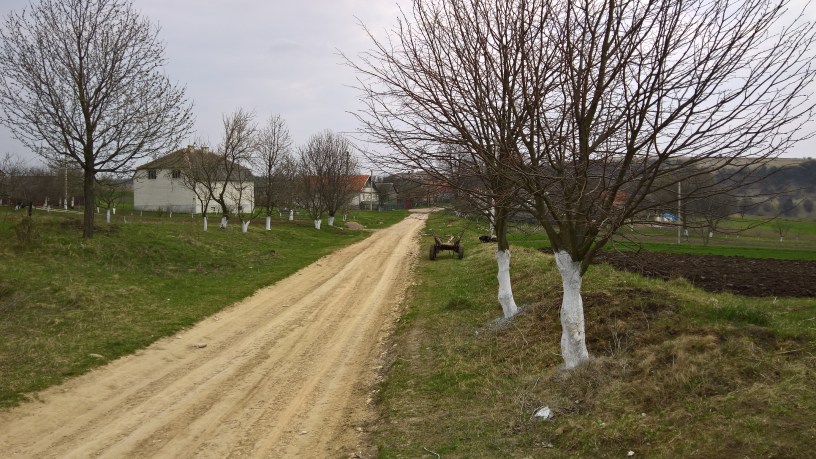
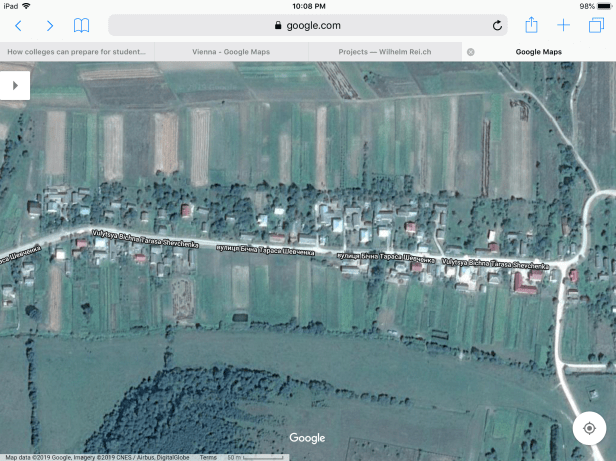
Then I stood in the countryside on a dirt road at the former site of the Leicht ancestral home. Neighboring farmhouses, like ours built for ethnic German colonists at the turn from 18th to 19th century, were long ago abandoned and on the verge of collapse. I gazed upon fields my family worked for at least four generations, and saw Ukrainian farmers using much the same methods as those German colonists – horse-drawn wagon and plow, rudimentary tools, human muscle. I visited the chapel where my ancestors prayed daily, and stood at the altar of the parish church, St. Nicholas in Bibrka, where my grandfather was baptized.


That’s when I knew exactly why I was there. This pilgrimage was for my soul. I had visceral need to put my hands in the soil my grandfather tilled, see where he worked and played, get a glimpse of how he lived then, and maybe understand why he left. To walk in his footsteps.


I firmly believe that if you don’t know where you came from, you will never fully understand who you are and where you are going.
I guess I’m a mush that way, as I did the same thing in my Italian homeland. Its part of my DNA, or at least my personality.


Take-aways here? I count three big ones:
- Timing is everything: I got to stand on the brink of an age that is about to pass into oblivion.
While there is but a shadow of how my Grandfather saw Rehfeld, I got to glimpse it. I could still grasp the context of his land, barely changed since then. Who knows how much longer that will hold? On the drive south from Lviv, we passed a recently built shopping mall and gleaming new stadium. Urban sprawl and modernization are inevitable as Ukraine’s economy grows. How soon before their equivalent of Home Depot is around the corner?
- Real People: On this journey, I spoke to more than ghosts.
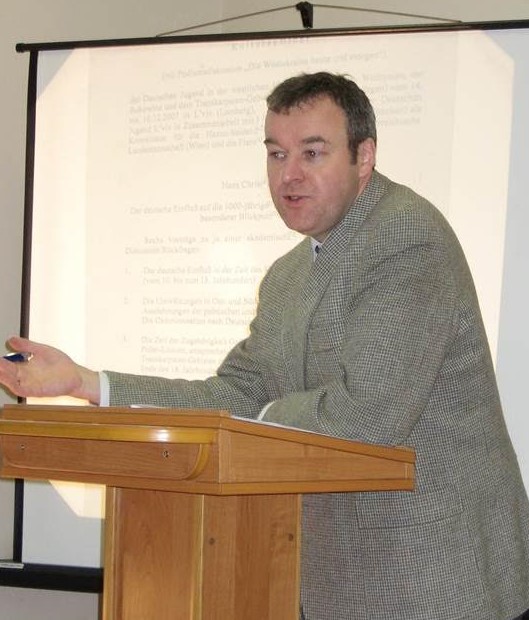
Like Professor Hans Christian Heinz, my intrepid guide. He is a German national living in Lviv with his Ukrainian wife and son, teaching at Lviv University and specializing in the history, culture and architecture of German settlements in Austrian Galicia. He taught me much about the two cultures, the region’s complicated history, the resources available for genealogy buffs like me, daily life in this part of the Ukraine, and a humble approach to most things. Our studies continue!
Like Andriy and Artur Burban. Planning this trip, I was certain not to find relatives. But when Prof. Heinz heard I was interested in Rehfeld and the Leicht family, he promised a surprise, as he recently assisted a local family on those subjects. Andriy, it happens, is my 4th cousin once removed, through his grandmother Stefaniy Leicht. Her grandfather, Johann Cantis Leicht, was born in Rehfeld in 1864 but left the colony in the mid-1880s to work as a clerk in the nearby village of Zhukov. There he fell in love with a local girl, Evdokia Salabai; they were married and raised their family there.


Our common ancestor was the Peter Leicht who settled in Rehfeld in 1820 with his two sons. I am directly descended from the oldest son, also named Peter, born 1808, my great-great grandfather. Andriy is directly descended from the younger son Josef, born 1813, his great-grandfather’s great-grandfather. Artur is Andriy’s teenage son and speaks some English so we could communicate during our day together. Sharing cellphone photos Andriy and I discovered that, besides genealogy, we both like to garden, cook and entertain in our homes. I found kin and kindred souls!
- An Adventure: Never fear the road less traveled.
I worried about visiting Ukraine, but I should have known better. The Lviv airport was clean and efficient, the people helpful, the city charming. Exploring the city, I treated myself to a beer and lunch at an outdoor café full of European tourists. The food was standard as in any other European capital, so I slightly scolded myself for not finding something more local. I did just that the next night for dinner, muddling my way through the menu to have a wonderful meal at an extremely reasonable price, with lots of local flavor.


I was charmed by the cobblestone streets; mix of baroque, renaissance and classic architecture; proliferation of youth in the city; and most of all the mix of old eastern and new western European accents. At points it was like seeing a photograph partly in color, partly in black-and-white. Lviv still has a patina from its Soviet years, but little by little it is starting to shine bright.


Whatever I had originally expected, this trip exceeded.
 So The Story Goes Like This...
Hans CH guided me to Bruckenthal twice. I enjoyed your story and it brought back many memories of me finding where my mother and father were baptized.
LikeLike