
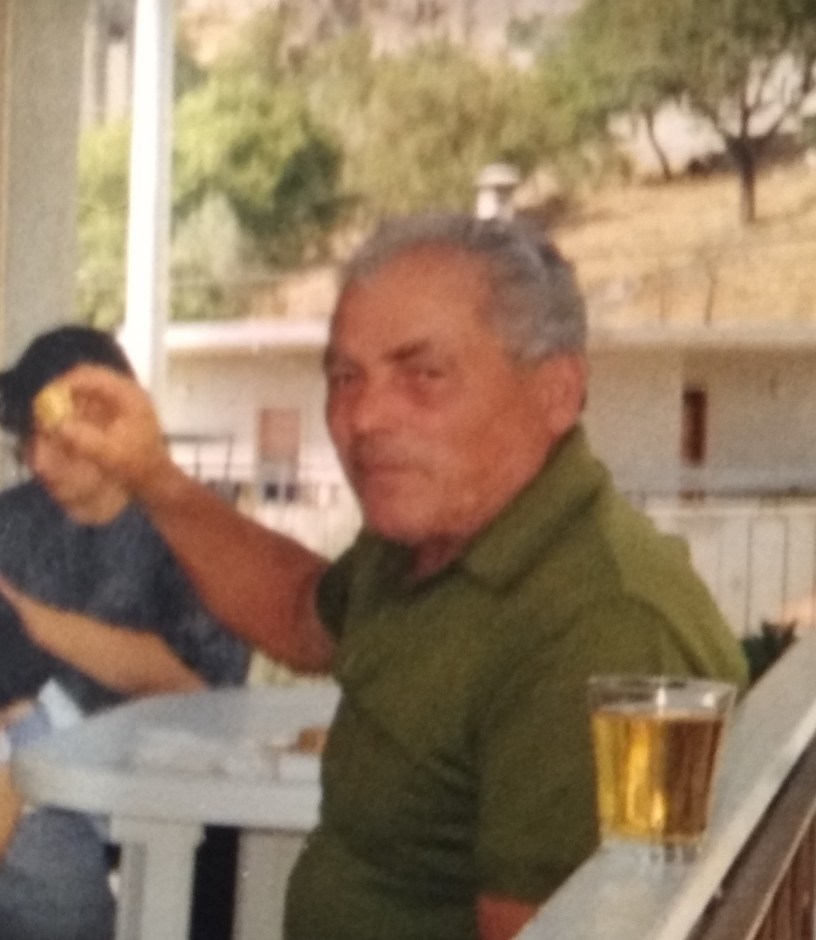
Every time I would go to Zio Angelino’s home in my ancestral town of Anagni, about 40 miles south of Rome, he wanted me to taste his latest wine – we were kindred souls that way.
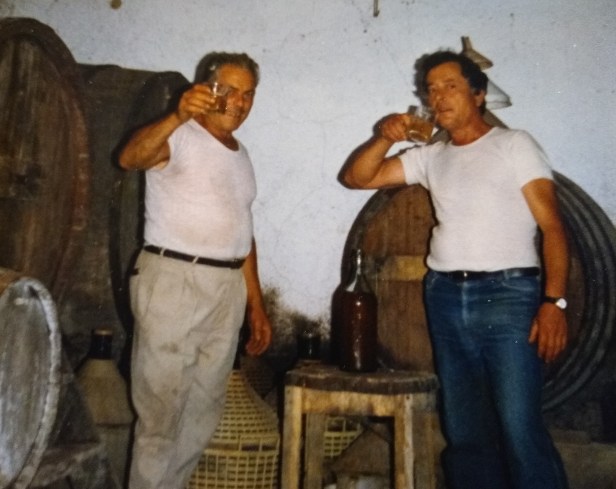
Zio in his cellar with his younger brother Peppino, about 1984
As soon as I walked in, he would ask me a simple question, in the local dialect: sei magnato? [say-mahn-YAH-toh?]. In Italian, it’s hai mangiato? [ay-mahn-JAH-toh], for have you eaten. The first few times I wasn’t quite sure why he was asking and I didn’t want to turn down hospitality (and I was a hungry 20-something at the time too), so I would always say no, I had not eaten. Immediately he would shuffle into the cupboard and cobble together a piece of cheese, maybe some of his prosciutto, and some crusty bread. Magnia, magnia, he would implore me – eat, eat! He would studiously make sure I was chewing properly and getting enough in, and then say bene, adesso assaggia questo! – good, now taste this! and hand me a small glass called a “gottino” (literally a throatful) of his latest homemade wine.
I later realized that he simply considered it a sin and a danger to drink on an empty stomach, so he made sure I had something in my belly to absorb the wine that was to come.
Zio means uncle in Italian. Angelo Gatti was not my proper uncle, but my mother’s first cousin – in the old-world culture and tradition of Anagni, it is a sign of respect to call an elder or even somebody from an older generation by the title Zio or Zia. I have second cousins once removed who still call me Zio, and I consider that an honor.
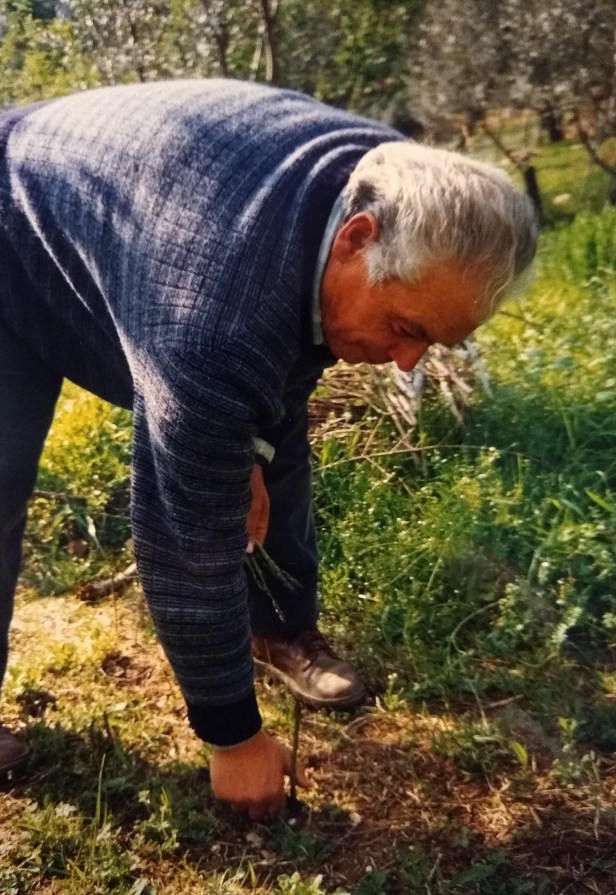


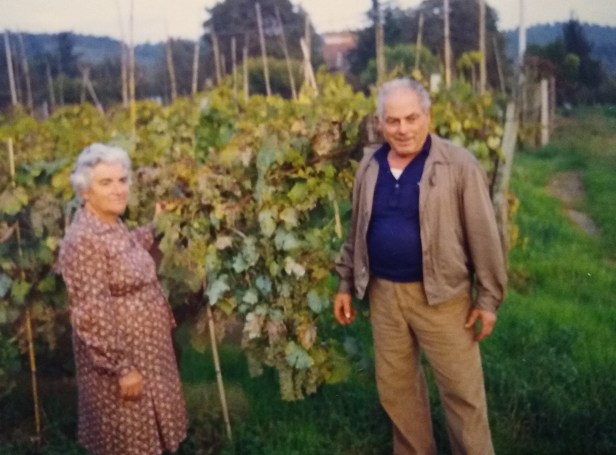
To describe Zio Angelino I used to like to tell people to just go to the dictionary and look up “Contadino Ciociaro,” or a farmer from our area of Italy, and there would be his picture. He was classic, and there wasn’t much he couldn’t do, fix, make or grow. His grandfather settled the homestead out in the hills away from town, one of the first to risk living outside of the town walls, as a subsistence farmer. Angelo’s father Eraldo, my grandmother’s brother, inherited that role until he passed in 1972, then Angelo became the ‘man of the mountain.’ Eventually he took work in factories, first in Rome then closer to home, to help support his family, but he and his wife Giovanna kept the farm fully operational, with sheep, chicken, pigs, pheasants, peacocks, cats and more, farming the land and tending their vineyards. Zia Giovannina made about eight loaves of bread once a week in the wood burning oven at the back of the house; once a year they would slaughter and butcher the pigs to feed their family throughout the year with sausages, prosciutto and more. Yet Zio was just as comfortable in his fields as he was in downtown Rome, in his rustic cellar as in the more modern wineries I took him to, in his humble four-room home as in the more opulent villas of his children and the American houses we visited together.


I was fortunate to live with Zio and Zia the first time I visited Anagni in 1984 and stayed at their house for every visit for about ten years after that. They treated me like a son, teaching me valuable lessons and recounting family history and tales. I got to harvest and make wine with them in 1992; when Zio came to the US for my wedding in 1995, he helped me rack the wine in my own cellar and worked so comfortably in it you would think he designed it himself. He was a great companion, always had a joke to share and a story to tell; a marvelous conversationalist and a fine drinking partner.
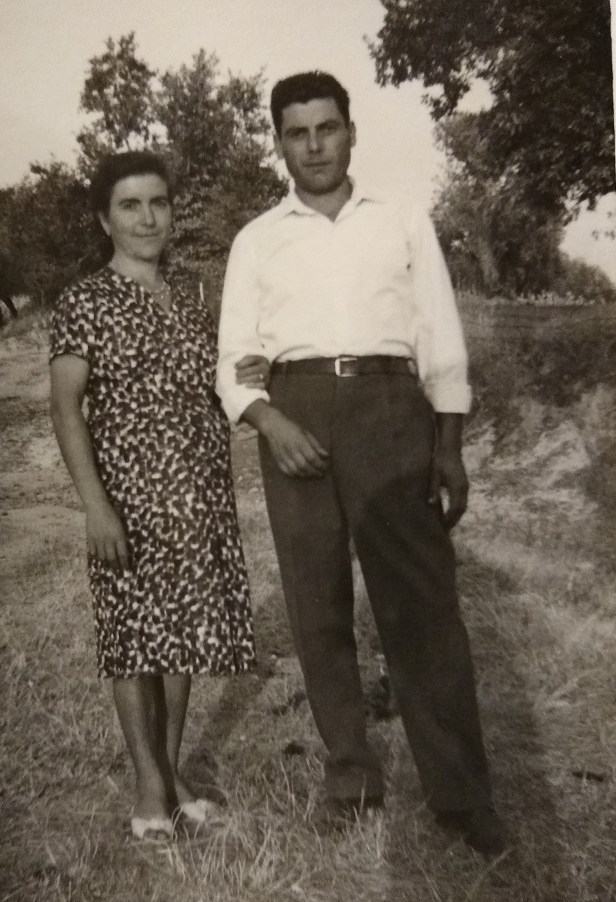

When Zia got sick and passed away in 1994, Zio tried to keep things going a bit but his age and missing his partner made that impractical. He would still occupy himself with some little projects now and then, but for the most part the old days were gone. I would be sure to visit Zio every time I got back to town, and often went to pick him up for dinner at his sister’s house. Zio fell at home one day and broke his femur; physical therapy was a battle, and he ended up in a nursing home for the past several years. He fell and broke his femur again the week before Christmas and became unresponsive and uncommunicative. Zio passed away on Christmas Eve.
I like to think that Zio Angelo is now back in his vineyard in the hills outside of Anagni, together with his beloved Giovannina, enjoying the fruits of their labor. I like to think that his father greeted him yesterday, and before sharing with him a glass of the finest wine he’d ever tasted, asked him a simple question: sei magnato?
 So The Story Goes Like This...
Nice tribute Lars.
I would like to offer my condolences to the family but not sure of the best way.
I remember when he came to visit and M&P brought him to Putnam Lake. I think I told you he was surprised that I was a woman cooking on the grill. I made Salmon.
He liked it up here on the hill.
Peace to you!
LikeLike
Thanks Karen, I will send you contact info for his children. I’m sure he loved Putnam Lake, it is a beautiful and peaceful spot! About his being surprised that a woman was cooking, there must have been more to it because women of his generation worked right alongside the men doing EVERYTHING; maybe he just wasn’t used to seeing American women working like that?
LikeLike