
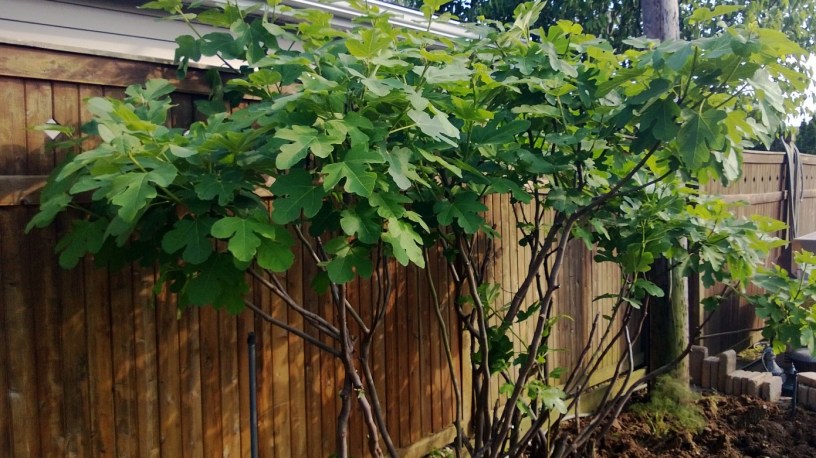
The fig tree. Ficus Carica.
One of the first trees cultivated by humans. A ubiquitous plant across the Mediterranean basin. Certainly popular in the central and southern regions of Italy. Not to mention in well-defined swaths of what could be called Italy’s 21st region – encompassing parts of Brooklyn and Queens.
Back in the day, it was enough to take a ride on the Belt Parkway to fin d the fig trees saluting from the properties lining the highway’s path. In mid-summer you might not be able to differentiate them from all the other sprouting greenery, but in the dreary winter they stood out. Wrapped in tar paper, with a plastic 5-gallon paint bucket over the top, a plastic overcoat lovingly laced around the whole thing. They were lined up like sentinels, guardians of the Italian culture at attention, ready to serve, yet coddled by their masters.
When I was growing up in Queens Village in the late 1960s and early 1970s, we had our fig tree, in a corner of the back yard. In Italy I’ve dined under the shade of a family fig tree with a trunk wide enough for a grown man to hug, but in our cooler climate (hence the winter wrap), they tend to be grow more bush-like. At least they did in our garden.
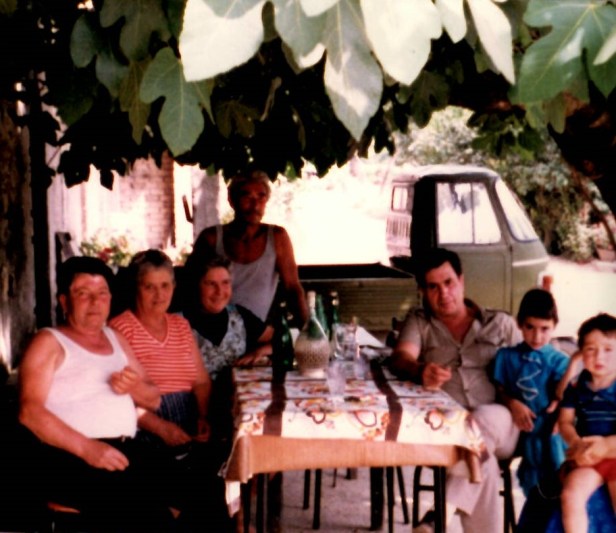
When my Italian grandmother, Maria, would come over, inevitably it drew her like a magnet. Ever the farm girl, despite a half century living in the Bronx, she would set to breaking away the dead wood, while my other beseeched her from the window to stop messing with the tree. “What do you know, Palma,” she likely asked. “I grew up with fig trees that, together with almond trees and other fruit trees, were planted between rows of grapevines in our family vineyard, acting as a stake for the lines that held up the vines – a living, fruit-bearing stake. I climbed them when I was a little girl, tended them when I was a young woman, and now visit with them as an old lady. Lascia mi stare.”
In 1973, we left Queens Village and moved further out to Long Island, fulfilling our share of the American dream built on Nana and Papa’s sweat, Mom’s sacrifices, and Dad’s overtime. But as is often the case, a part of our history came with us – not just the winemaking equipment and the garden tools, but a cutting from ‘the’ fig tree. Nobody knows anymore how we got it in the first place – did it come from Italy? Was it a cutting from Nana and Papa’s house in the Bronx? Boh. It didn’t matter. For two decades it was part of our life in QV, and it was coming with us to Jericho.
Dad carefully planted the tree against the west wall of our new home, where the afternoon sun reflecting off the bricks to warm the tree, and it in turn would shade our patio. We weren’t so good about covering it in the winter – in fact, we never did. If we had a cold snap, the upper branches would die off and we would break them like Nana taught us. But fresh growth always came from the bottom. Some years we got a handful of figs and they were delicious treasures. Most years we got little if any. But the tree continued to grow up with us kids and be a part of our life.
Then Mom got sick. Cancer found her. She proved a formidable foe, tough as nails (no surprise to those of us whom she raised). Alas, cancer pretty much always wins. But here’s what Palma got out of the fight:
After her third operation in as many years, around 1989, we got a call from the doctor early one morning that she was slipping away. We were not ready to let her go, and didn’t know what to do, but we knew we didn’t want to lose her. Perhaps foolishly, we rushed to her bedside and beseeched her to fight. And fight she did. After a few days in intensive care she rallied, and another week or so in the hospital, she was back home. We had a hospital bed set up in our ground-floor family room, with day-long nursing care, and a bed for me to sleep nearby her to monitor and help care for her. She gave us three more months of love and memories through her struggle.
During those days, as spring turned to summer, the visiting nurses would walk her out the back door and into the yard, passing by the fig tree. She always paused there. With one hand on her walker, she would raise the other frail arm up to the branches and make her inspection. “Are you gonna give us any figs this year,” she beseeched. Every day, through June, July and the first days of August, she continued her query.
Mom passed on August 15, 1989. “I knew you would go to heaven on the feast of the assumption,” her beloved sister-in-law Betty said to her at the funeral home. We buried Mom a few days later, and then set to straightening up the house that had been her domain, inside and out. The hospital bed went away, the rooms inside went back to normal, and Dad and I returned to tending the garden. Every once in a while I would pass under the fig tree and, as if to keep at least her hope alive, would ask: “are you gonna give us any figs this year?”
Some time around early to mid-September, we got our answer. We found some purple figs. “How nice,” we thought, “some figs for Mom.” I’m pretty sure we even brought the first few to the cemetery to lay on her grave.
And then the deluge started.
More figs. Baskets full every day. Hundreds of figs, like that tree – like no tree — had ever given before.
And every year after that, for a straight decade, we had bumper crops of Palma’s figs. We savored each one.
Then, after exactly ten years, she stopped. Sure, we got some figs, but no more of the “fishes and loaves” miracle that we had been blessed with. It went back to normal. I guess our lives did too, if normal means that we continue to live with signs of Mom every single day.
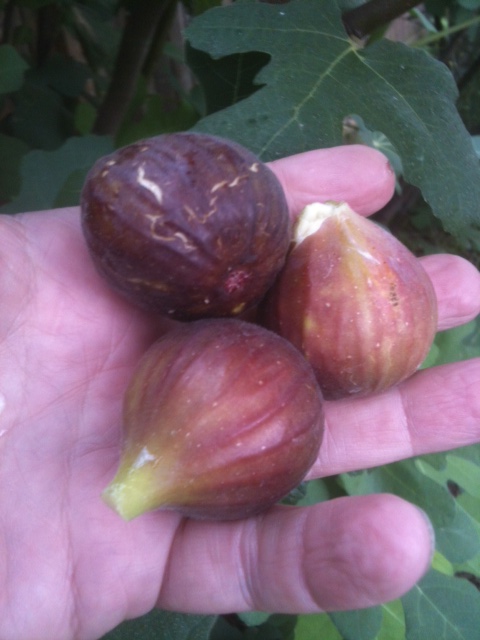
Author’s Note: Yesterday – January 20, 2018 – Palma would have been 95 years old. She’s been gone for 29 years, but never really left us.
 So The Story Goes Like This...
Great story. I hope my tree provides this year. Last year they never matured before it got cold.
LikeLike